
When it comes to clearing overgrown land, managing pasture, or maintaining rural properties, two machines often come up in conversation: the flail mower and the brush hog (also called a rotary cutter). At first glance, they might seem similar because both are designed to cut thick grass, weeds, and light brush. However, they work very differently and produce very different results.
This guide breaks down the differences in a practical way so you can decide which one fits your needs.
Flail Mower vs Brush Hog
| Feature | Brush Hog (Rotary Cutter) | Flail Mower |
|---|---|---|
| Cutting Mechanism | Large horizontal spinning blades | Multiple small Y or hammer flails on a rotating drum |
| Cut Quality | Rough, uneven cut | Fine, clean, mulched finish |
| Best Use Case | Overgrown fields, pasture clearing | Roadsides, parks, orchards, landscaped areas |
| Ability to Handle Thick Brush | Very strong (small saplings, heavy weeds) | Good (brush + grass, but slower in dense material) |
| Finish Appearance | Shredded, rough vegetation | Smooth and uniform ground cover |
| Safety | Higher risk of throwing debris | Safer due to enclosed cutting system |
| Speed of Work | Faster over large rough areas | Slower but more precise |
| Maintenance | Simple, fewer parts | More complex, more moving parts |
| Cost | Usually cheaper | Usually more expensive |
| Mulching Ability | Poor (coarse clippings) | Excellent (fine mulch decomposes quickly) |
| Terrain Suitability | Rough, uneven, rural land | Managed land, roadsides, mixed vegetation |
| Operator Skill Needed | Low to moderate | Moderate (for best results) |
Related Reel Mower vs Rotary Mower(Complete Comparison)
What Is a Brush Hog?
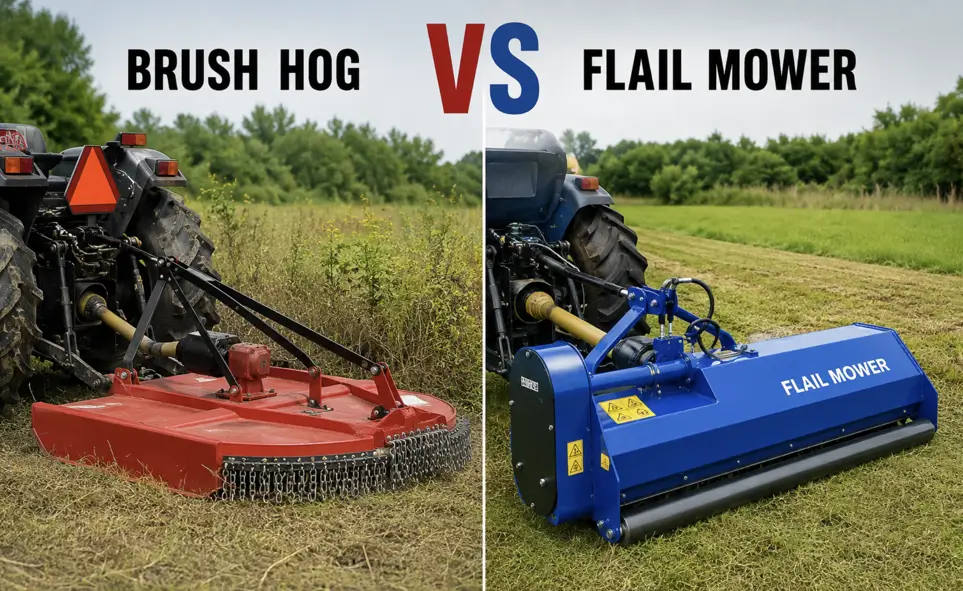
A brush hog is a heavy-duty rotary mower that attaches to a tractor’s PTO (power take-off). It uses one or more large, horizontally spinning blades to chop through thick vegetation.
Brush hogs are built for power and durability. They are commonly used on farms, large properties, and fields where appearance is not the top priority.
Key Features of Brush Hogs:
- Large spinning blades (usually 1–2 heavy blades)
- Cuts thick weeds, tall grass, and small saplings
- Rear discharge of cut material
- Simple mechanical design
- Typically cheaper than flail mowers
Best Uses:
- Overgrown fields
- Pasture maintenance
- Fence line clearing
- Light brush and saplings
A brush hog is essentially a “rough cut” machine. It gets the job done quickly but leaves behind uneven, shredded vegetation.
Related Finish Mower vs Brush Hog(Comprehensive Comparison)
What Is a Flail Mower?
A flail mower uses many small blades (called flails) attached to a rotating drum. These flails swing freely and chop vegetation into very fine pieces.
Instead of a rough cut, a flail mower produces a clean, mulched finish that decomposes quickly and evenly.
Key Features of Flail Mowers:
- Multiple small Y or hammer flails
- High-speed rotating drum
- Fine mulching of grass and brush
- Safer debris containment
- More precise cutting height control
Best Uses:
- Roadsides and highways
- Parks and landscaped areas
- Orchards and vineyards
- Residential large lawns
- Areas requiring a clean finish
A flail mower is all about precision and appearance, not just raw cutting power.
Related Briggs & Stratton vs Kohler(Complete Comparison)
Flail Mower vs Brush Hog: Key Differences
Here’s a clear breakdown of how they compare:
1. Cutting Performance
A brush hog is designed to tear through thick vegetation quickly. It can handle rough terrain and uneven patches without much concern for finish quality.
A flail mower, on the other hand, is designed to cut and mulch finely. It produces a uniform and tidy surface, even in moderately overgrown areas.
Winner:
- Brush Hog: For raw cutting power
- Flail Mower: For a clean finish
2. Finish Quality
Brush hogs leave behind chunky, uneven clippings. You will often see clumps of grass and shredded stems.
Flail mowers leave a finely chopped mulch, which decomposes faster and looks much neater.
Winner: Flail Mower
3. Safety
Brush hogs can throw rocks, sticks, and debris long distances because of their exposed blades and high-speed rotation.
Flail mowers are much safer because the cutting action is enclosed, and debris is contained under the deck.
Winner: Flail Mower
Related Kohler vs Kawasaki(A Detailed Comparison)
4. Durability and Maintenance
Brush hogs are simpler machines, meaning fewer moving parts and easier repairs. They are very tough in harsh conditions.
Flail mowers have more components (many flails, bearings, belts), which means more maintenance but also more versatility.
Winner: Brush Hog (for simplicity)
5. Cost
Brush hogs are generally cheaper upfront and easier to maintain.
Flail mowers cost more due to their complex design and precision engineering.
Winner: Brush Hog
6. Versatility
Flail mowers can handle grass, weeds, leaves, and light brush while still delivering a fine finish. Some models can even cut vertical surfaces like hedges or roadside banks.
Brush hogs are more limited to rough field mowing.
Winner: Flail Mower
7. Speed of Work
Brush hogs cover large areas faster because of their wide cutting path and aggressive blades.
Flail mowers work more slowly because they process vegetation more finely.
Winner: Brush Hog
Related Rear Blade vs Box Blade(Complete Comparison)
Pros and Cons Summary
Brush Hog Pros:
- Powerful and fast
- Lower cost
- Simple design
- Great for rough terrain
Brush Hog Cons:
- Rough, uneven finish
- Less safe (debris throw)
- Not ideal for landscaped areas
Flail Mower Pros:
- Very clean finish
- Safer operation
- Better mulching
- More versatile cutting options
Flail Mower Cons:
- More expensive
- Slower operation
- Higher maintenance
Which One Should You Choose?
The decision comes down to your priorities:
Choose a Brush Hog if:
- You manage large open fields
- You want fast clearing of overgrown land
- You don’t care about appearance
- You need a budget-friendly option
Choose a Flail Mower if:
- You need a clean, professional-looking finish
- You work near roads, homes, or public areas
- You want a safer operation
- You need mulch for soil improvement
Final Thoughts
Both flail mowers and brush hogs are excellent tools, but they serve different purposes. A brush hog is all about power and speed, while a flail mower focuses on precision and cleanliness.
If you’re managing rough farmland or clearing neglected fields, a brush hog is often the best starting point. But if you want a polished finish and safer operation, especially in areas where people or property are nearby, a flail mower is worth the investment.
Understanding the difference helps you avoid buying the wrong equipment and ensures your land maintenance work is efficient, safe, and suited to your goals.